The Best Uruguay Jerseys of All Time
A guide to the best Uruguay jerseys of all time, from the 1930 World Cup winners and the 1950 Maracanazo shirt to the modern celeste kit.
August 17, 2026 · 6 min read · sidejersey
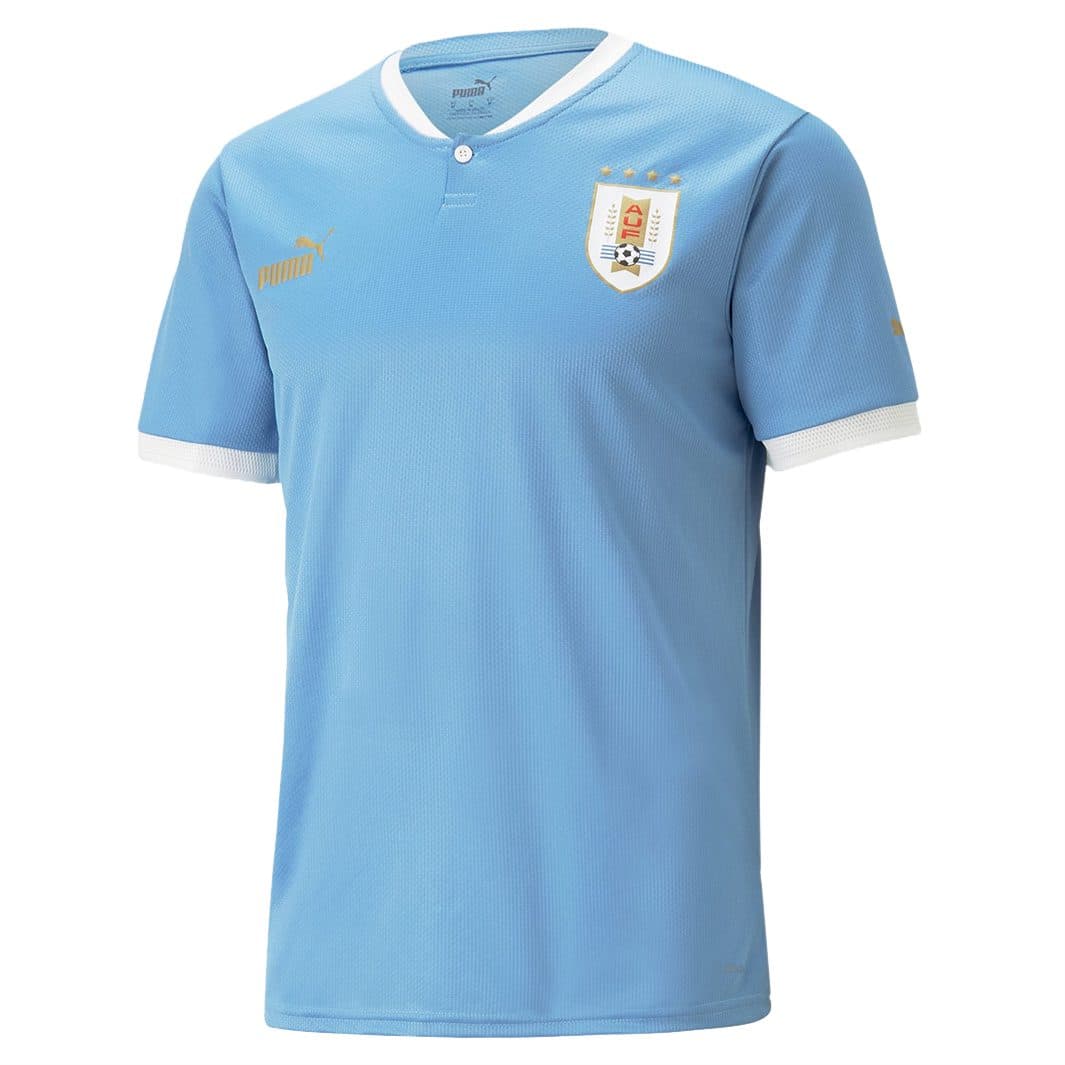
Few shirts in world football carry as much history per square inch as the sky blue of La Celeste. Uruguay jerseys tell the story of a nation of barely 3.4 million people that has won the World Cup twice, and they remain some of the most quietly beautiful kits ever produced.
Why Uruguay Jerseys Are Sky Blue
Uruguay did not always play in celeste. The national side wore a mix of colours in its earliest years, and the sky blue only became permanent after 1910, when Club Atlético River Plate of Montevideo beat Argentina's Alumni while wearing that shade. The colour was adopted by the national team shortly afterwards and never left. It is one of the few international kits whose colour has no direct link to the national flag — the Uruguayan flag is blue, white and gold — and that quirk is part of what makes the shirt so distinctive on a shelf full of red, white and green.
If you like kits with a proper origin story, you will find plenty more across our South America jersey range and the wider national team collection.
1930: The Shirt That Won the First World Cup
Uruguay hosted and won the inaugural World Cup in 1930, beating neighbours Argentina 4–2 in the final at the Estadio Centenario in Montevideo. The stadium was purpose-built for the tournament and finished only days before kick-off. Captain José Nasazzi lifted the trophy in a plain sky blue shirt with a modest collar, no sponsor, no manufacturer logo and no squad number — numbering did not become standard in international football until the following decade.
That 1930 template is why so many modern Uruguay jerseys keep things minimal. Designers know that the moment you clutter a celeste shirt, you lose what makes it special. You can see the same restraint at work in plenty of the shirts in our classic jerseys section. FIFA's own archive of the 1930 tournament is worth a browse if you want the full picture.
1950 and the Maracanazo
The most famous celeste shirt of all belongs to 13 July 1950. Brazil needed only a draw in the final match of the round-robin decider at the Maracanã, in front of a crowd generally reported at around 200,000. Uruguay won 2–1 through Juan Alberto Schiaffino and Alcides Ghiggia, with captain Obdulio Varela dragging the team through by force of will.
The shirt itself was simple: sky blue, black shorts, a small crest. It is proof that a kit does not need a graphic print to become iconic — it needs a night like that. For the other side of that story, our Brazil jersey range covers the shirt that was supposed to win it.
The Four Stars Above the Crest
Look closely at a modern Uruguay jersey and you will count four stars above the AUF crest, despite only two World Cup wins. The other two represent Olympic gold medals from Paris 1924 and Amsterdam 1928, which FIFA at the time treated as world championships for football. It is a talking point every four years, and it is one of the reasons Uruguay jerseys start conversations in a way that most kits do not. If you want the wider background on kit stars and crests, our FAQ page covers a lot of the common questions we get asked.
The Adidas Years: 1986 and 1990
Uruguay returned to the World Cup in 1986 after a long absence, wearing an Adidas kit with the three stripes running down the sleeves — a template shared with several European sides of the era. Enzo Francescoli, El Príncipe, was the star, and his elegance suited the shirt perfectly. The 1990 Italia shirt followed a similar path: sky blue, black shorts, understated trim.
These late-eighties designs are among the most requested retro shirts we see, sitting alongside the great Argentina jerseys and Italy jerseys of the same period.
2010: The Forlán Jersey
South Africa 2010 was Uruguay's best World Cup in 40 years. They finished fourth, Diego Forlán won the Golden Ball as player of the tournament, and Luis Suárez produced one of the most argued-about moments in the competition's history with his goal-line handball against Ghana in the quarter-final. Puma, who have supplied Uruguay's kits since the late 1990s, produced a clean celeste shirt with a subtle tonal finish for that campaign.
For a lot of fans under 35, this is the Uruguay jersey. It marks the point where La Celeste stopped being a historical curiosity and became a side nobody wanted to draw again.
The Modern Uruguay Jersey
Recent Uruguay jerseys have leaned into texture rather than pattern — tonal weaves, gold detailing on the crest, and cleaner collars. The current generation gives the shirt genuine star power: Federico Valverde in midfield, Ronald Araújo at the back, Darwin Núñez up front, with Rodrigo Bentancur and Manuel Ugarte alongside them. Marcelo Bielsa took charge in 2023 and pushed the side towards a far more aggressive pressing game.
If you follow those players at club level too, our La Liga jerseys and Premier League jerseys sections are the obvious next stop, and the full club teams range goes wider still.
Uruguay at World Cup 2026
The 2026 World Cup is the first 48-team edition and the first to be co-hosted by three countries: the United States, Canada and Mexico. For Uruguay it also carries symbolic weight — 2030 will mark a century since they won the first tournament, and the celeste shirt will be everywhere in the build-up.
Everything we stock for the tournament sits on our World Cup 2026 jerseys hub, and you can browse the host nations through our North and Central America range, including the ever-popular Mexico jerseys.
How to Choose Your Uruguay Jersey
Authentic or replica?
Authentic shirts use lighter, more technical fabric with laser-cut ventilation and a heat-pressed crest, cut slim to match what the players actually wear. Replicas use a slightly heavier knit, an embroidered crest and a roomier fit. Both are officially licensed; the replica is simply the everyday version.
Getting the fit right
Uruguay jerseys follow standard Puma sizing, which runs a touch closer to the body than some other brands. If you are between sizes, or you plan to wear a layer underneath in winter, size up. Our size guides are linked on every product page.
Names and numbers
The obvious picks are Valverde, Núñez and Araújo, but a retro-styled 10 for Francescoli or a Forlán 10 works beautifully on celeste because the white lettering has so much contrast to play with.
Where Uruguay Jerseys Sit Among the Greats
Ranked purely on design, the celeste belongs in the same conversation as Brazil's yellow, Argentina's stripes and the Netherlands' orange — but it gets far less attention, which is exactly why it is such a good shirt to own. It is recognisable without being obvious. Alongside the great Europe jerseys such as the England, Germany, France, Spain and Portugal shirts, a Uruguay jersey stands out for the right reasons.
Get Your Uruguay Jersey Before the World Cup Rush
Demand for South American shirts climbs sharply once the group draw lands, and the popular sizes are always first to go. Browse the full South America collection and the World Cup 2026 range to secure yours early. If you want to know more about how we source and ship our kits, have a read of our about us page.